

AI agent governance is the set of controls monitoring, audit trails, and guardrails that keep automated customer conversations accurate, traceable, and safe. For ops leaders rolling out AI agents at scale, governance isn't optional overhead; it's the difference between a scalable support channel and a compliance incident waiting to happen.
What AI agent governance means for customer conversations
Governance covers three things: what the AI agent is allowed to say, how its decisions are logged, and how humans catch and correct mistakes before they compound. In practice, this means defined response boundaries, conversation logging, escalation rules, and a review process that doesn't rely on customers reporting problems after the fact.
For teams running AI agents across WhatsApp, web chat, and other channels, governance has to work the same way everywhere a customer can reach you not just on the channel someone remembered to configure last.
Why accuracy, traceability, and safety matter in automated support
Three risks show up repeatedly when AI agents handle customer conversations without proper controls:
- Accuracy drift an agent gives a correct answer in testing, then starts hallucinating edge-case responses once it hits real conversation variety.
- Lost traceability when a customer disputes what they were told, there's no reliable record of the exact exchange.
- Unsafe escalation handling an agent keeps trying to resolve a complaint it should have handed to a human, frustrating the customer and creating liability.
Each of these is manageable with the right setup. None of them are manageable if governance is an afterthought.
Setting up AI agent monitoring to catch errors early
Monitoring means watching what your AI agent actually says in production, not just what it says in a demo. That requires:
- Real-time visibility into live conversations, not just post-hoc sampling
- Flagging for low-confidence responses or topics outside the agent's trained scope
- Clear ownership someone on your ops team reviews flagged conversations daily, not monthly
The goal is catching a bad answer in the first hour it appears, not the first week a customer complains loudly enough to escalate internally.
Building an audit trail for every automated interaction
An audit trail means every automated interaction message sent, action taken, handoff triggered is logged with a timestamp and tied to the customer record. This matters for three reasons:
- Dispute resolution you can show exactly what was said and when.
- Quality review your team can pull a sample of conversations and assess whether the agent is performing to standard.
- Regulatory readiness if your industry requires records of customer communications, automated conversations need to meet the same bar as human ones.
An audit trail that only covers some channels or some conversation types isn't an audit trail it's a gap waiting to be found during a review.
Guardrails that reduce AI customer service risk
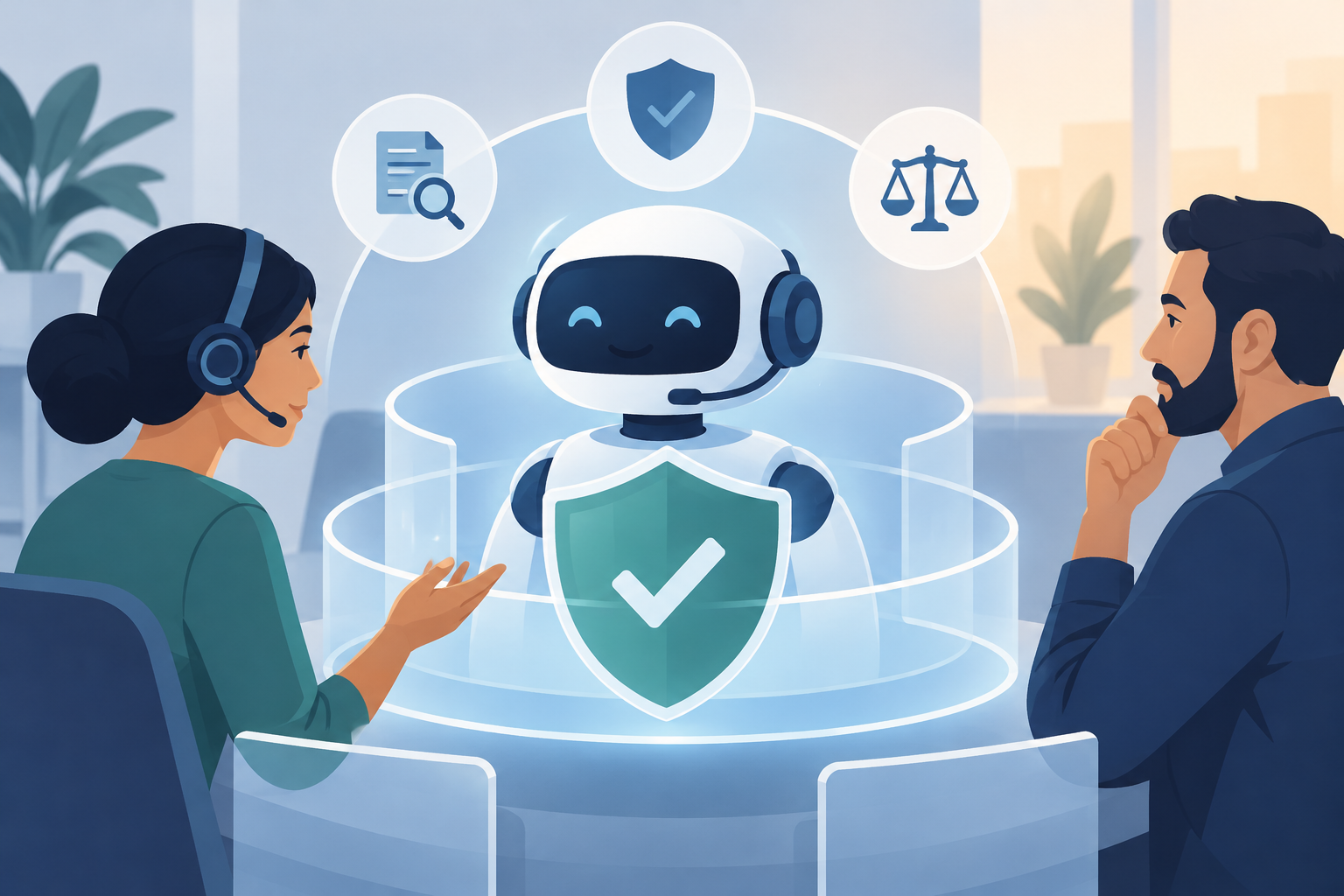 Guardrails are the rules that constrain what an AI agent can do, regardless of how a conversation unfolds. Useful guardrails include:
- Scope limits—topics the agent is explicitly not authorized to discuss (pricing exceptions, legal commitments, account cancellations without verification)
- Mandatory escalation triggers—keywords or sentiment signals that force a handoff to a human agent
- Confirmation steps before irreversible actions, like processing a refund or closing a ticket
- Rate limits on repeated attempts, so an agent doesn't loop a frustrated customer through the same failed resolution path
Guardrails work best when they're built into the automation layer itself, so they apply consistently rather than depending on an agent "remembering" the rule in every conversation.
Best practices for safe, accountable AI agent deployment
- Start with a narrow, well-defined scope and expand only after monitoring shows consistent accuracy
- Review flagged conversations on a fixed schedule, not reactively
- Keep a human-in-the-loop path for every automated flow, with clear criteria for when it triggers
- Treat your audit trail as a compliance asset, not just a debugging tool know who can access it and for how long records are retained
- Revisit guardrails whenever you add a new channel, product, or use case; rules that worked for one conversation type may not transfer cleanly
How mobitech fits
Mobitech.ai runs AI agent governance as part of the platform, not as a bolt-on. Every conversation handled by AI agents flows through the same omnichannel inbox as human-handled chats, so there's one conversation record per customer no separate log to reconcile. Automation rules define escalation triggers and scope limits at the workflow level, so guardrails apply consistently across WhatsApp, web chat, and other connected channels rather than being reconfigured per bot. Ticketing and CRM modules tie each automated interaction to a customer record, giving ops teams a traceable history for review or dispute resolution without extra tooling. For details on what's included at each plan level, see pricing.
Talk to us about deploying AI agents with governance built in
If you're evaluating AI agents for customer service and need monitoring, audit trails, and guardrails that hold up under scrutiny, talk to our sales team about how mobitech.ai handles governance across your channels.