

AI customer support errors spike during holiday rush because order volume, promo codes, and policy exceptions outpace what your bots were trained on. Fixing this before peak season means auditing accuracy, refreshing knowledge bases, retraining on known failure patterns, and setting firm human handover rules not just adding more automation.
Why AI customer support errors spike during holiday rush
Holiday traffic breaks AI agents in predictable ways. Order volume triples, so edge cases that rarely surfaced in October show up hundreds of times in November. Promotions change weekly, so a bot trained on last month's return policy confidently gives customers the wrong answer. New SKUs, flash sales, and shipping cutoffs all get introduced faster than most teams update their training data. The result: AI response accuracy quietly degrades right when customers need it most, and the errors compound because everyone is slower to notice them during a rush.
The fix isn't disabling automation during peak season that just shifts the backlog to your human team. It's tightening the system before volume hits.
Auditing AI response accuracy before peak season
Start with a sample, not a guess. Pull the last 4–6 weeks of resolved and escalated conversations and score them against three questions: Was the answer factually correct? Did it match current policy? Did the customer need a human afterward anyway?
Look specifically for:
- Repeated wrong answers on the same topic (a training gap, not a one-off)
- Confident-sounding responses that are actually outdated
- Conversations where the bot should have escalated but didn't
This audit gives you a prioritized list of what to fix first, instead of retraining everything blindly. Teams running this check two to three weeks out from peak season catch most of the high-frequency mistakes before they scale.
Updating knowledge bases for seasonal promotions and policies
Most AI chatbot mistakes during the holidays trace back to a stale knowledge base, not a bad model. If your promo terms, extended return windows, shipping cutoff dates, or gift-wrap policies aren't reflected in the source documents your AI agent pulls from, it will answer with the old version every time.
Build a single source of truth for seasonal policy and update it before volume hits — not reactively, mid-sale. Version and date every policy document so your team (and your AI) is never working off last quarter's rules. If you're running flash promotions tied to ad campaigns, make sure the terms referenced in your digital ads integration match what support is telling customers, or you'll generate complaints the AI then has to clean up.
Retraining chatbots to close common mistake patterns
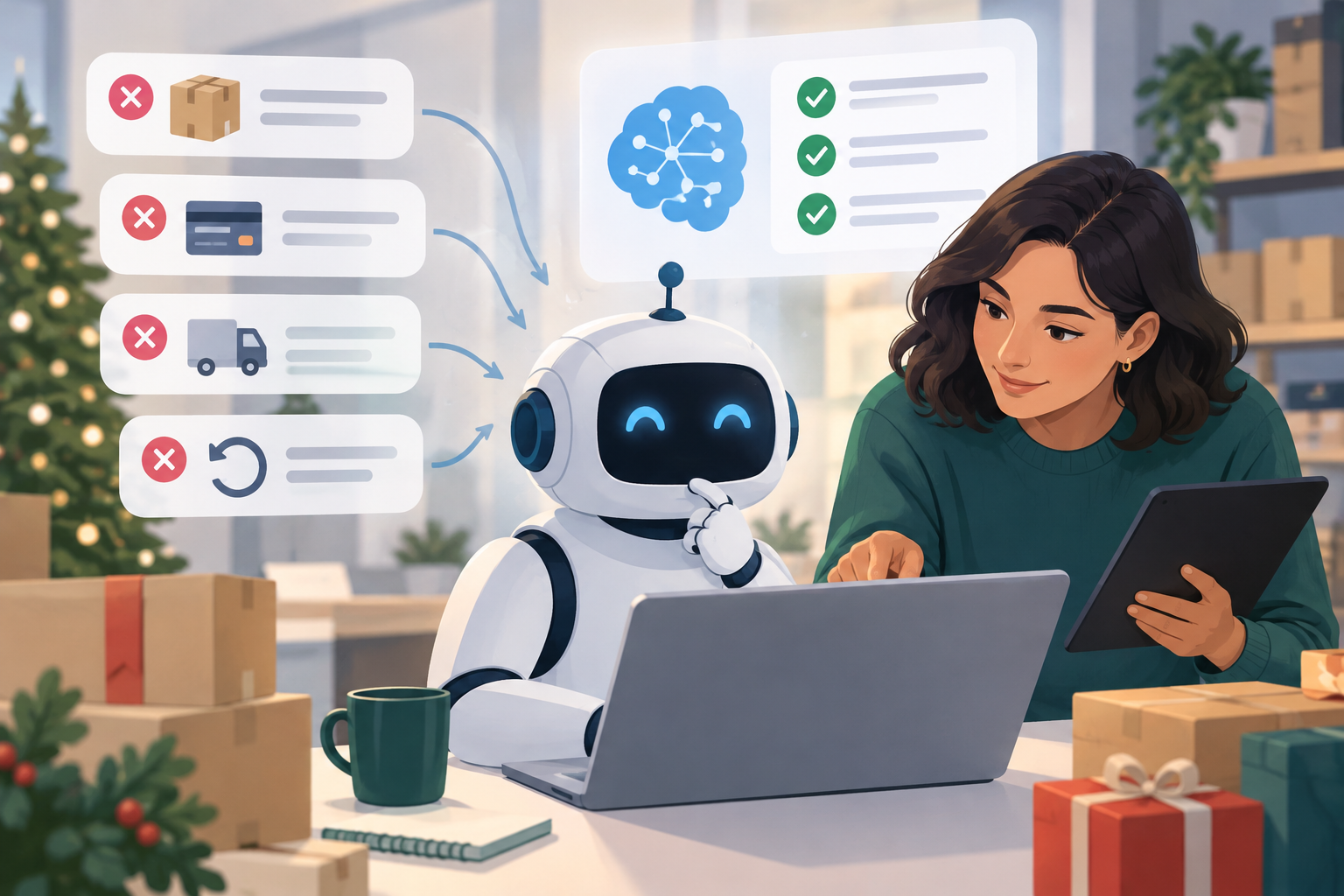 Once you've identified the recurring errors from your audit, retrain narrowly. Feed the AI agent corrected examples for the specific failure patterns you found wrong return windows, incorrect delivery estimates, mismatched discount stacking rules rather than a full retrain that risks introducing new gaps.
Test each fix against the original failing conversation before pushing it live. This is also the point to tighten tone and scope: holiday support includes more anxious, time-pressured customers, so responses should be shorter, more direct, and quicker to offer a human option when confidence is low.
Setting clear rules for human handover and escalation
The highest-risk AI customer support errors aren't wrong answers they're wrong answers the bot never flags as uncertain. Define explicit handover triggers:
- Order value above a set threshold
- Repeated customer frustration signals (all caps, repeated contact, refund language)
- Any topic outside the current, dated knowledge base
- Payment disputes or delivery failures
Route these straight to a human queue with full conversation history attached no re-explaining required. This is where having support, sales, and order data in one place matters: a WhatsApp CRM view means the agent picking up the handover sees order status, past tickets, and loyalty tier instantly, instead of asking the customer to repeat themselves while they're already frustrated.
Pre-holiday testing checklist for AI customer support
Run this before your first major sale event:
- Accuracy spot-check 50+ live conversation samples scored against current policy
- Knowledge base date audit every policy document stamped with last-updated date
- Load test simulate peak concurrent conversation volume, not just message count
- Escalation path test confirm handover triggers actually route to a live queue, not a dead end
- Cross-channel consistency check same answer on WhatsApp, web chat, and any other channel in your omnichannel inbox
- Rollback plan know how to revert a bad knowledge base update fast if something breaks mid-sale
Teams that run this checklist with time to spare go into peak season fixing known issues instead of discovering them in front of customers.
How mobitech.ai fits
mobitech.ai is built for exactly this kind of pre-holiday tightening. AI agents pull answers from a connected, versioned knowledge base, so a policy update applies instantly across every channel instead of waiting on a manual bot retrain. Escalation rules are configurable at the trigger level order value, sentiment, topic so handovers route to the right queue with full context, not a cold transfer.
Because the WhatsApp CRM, ticketing, and omnichannel inbox sit on one platform, agents picking up an AI handover see order history, past conversations, and CRM data in the same screen no toggling between systems mid-conversation with an already-impatient holiday shopper. Automation handles the repetitive seasonal volume (order status, shipping cutoffs, return windows); your team handles the exceptions the AI correctly flags instead of guessing on.
If you're preparing for a holiday spike and want to see how accuracy audits, retraining, and escalation rules work in practice, check pricing and start a trial before peak season hits.