

Holiday shopping compresses a year's worth of customer contact into six weeks. Order status checks, return requests, and refund questions arrive faster than human teams can triage them manually. The fix isn't more headcount it's AI that sorts, routes, and resolves routine inquiries automatically, freeing agents for the cases that actually need a human judgment call.
Why Holiday Volume Breaks Traditional Support Models
Most retail support stacks are built for average-day volume, not peak-day spikes. Ticket queues that clear in hours during normal months back up for days in December. Shoppers who can't get a fast answer on a return or a delayed order don't wait patiently they escalate, chargeback, or leave a public review. Seasonal temp staff help with headcount but rarely have the product or policy knowledge to resolve complex cases on first contact, which means supervisors spend the holidays firefighting instead of managing.
The structural problem is that inquiry volume and complexity both spike at once, but the mix skews heavily toward repetitive, answerable-in-seconds questions: "Where's my order," "How do I return this," "When will my refund post." Without automation to absorb that volume, those simple questions consume the same queue time as genuinely complex cases.
Triaging Inquiries: Using AI to Sort Returns, Refunds, and General Questions
The first lever is triage. An AI agent sitting in front of your inbox can read incoming messages across WhatsApp, email, or web chat and classify intent in real time: return request, refund status, general product question, shipping issue, or complaint. That classification does two things immediately. It lets straightforward questions get answered instantly without ever touching a human queue, and it tags everything else with enough context (order number, product, issue type) that the agent who picks it up isn't starting from zero.
For holiday customer service specifically, this triage layer matters more than usual because the question mix shifts: gift returns, exchange requests, and "wrong size" messages spike right after major shopping days and again right after the holidays. An AI agent trained on your return policy and order data can handle the bulk of these without a ticket ever reaching a rep.
Automating Returns and Refund Processing at Scale
Returns are the single biggest driver of holiday support volume, and they're also the most process-driven which makes them ideal for automation. A well-configured workflow can verify order eligibility, generate a return label, confirm receipt, and trigger the refund, all without manual intervention for the majority of standard cases.
This is where automation does the heavy lifting: connecting your helpdesk, CRM, and order system so a customer's return request moves from "submitted" to "refund issued" on rules you define, not on an agent manually checking three systems. The result is faster refunds for customers and far fewer status-check follow-ups clogging the queue a customer who already got an automated refund confirmation doesn't need to ask where it is.
Automated refunds also reduce a quieter cost: agent fatigue from doing the same five-step return process hundreds of times a day during peak season. Removing that repetitive work is often what keeps experienced agents focused on cases that need them.
Routing Complex Cases to Human Agents Without Delay
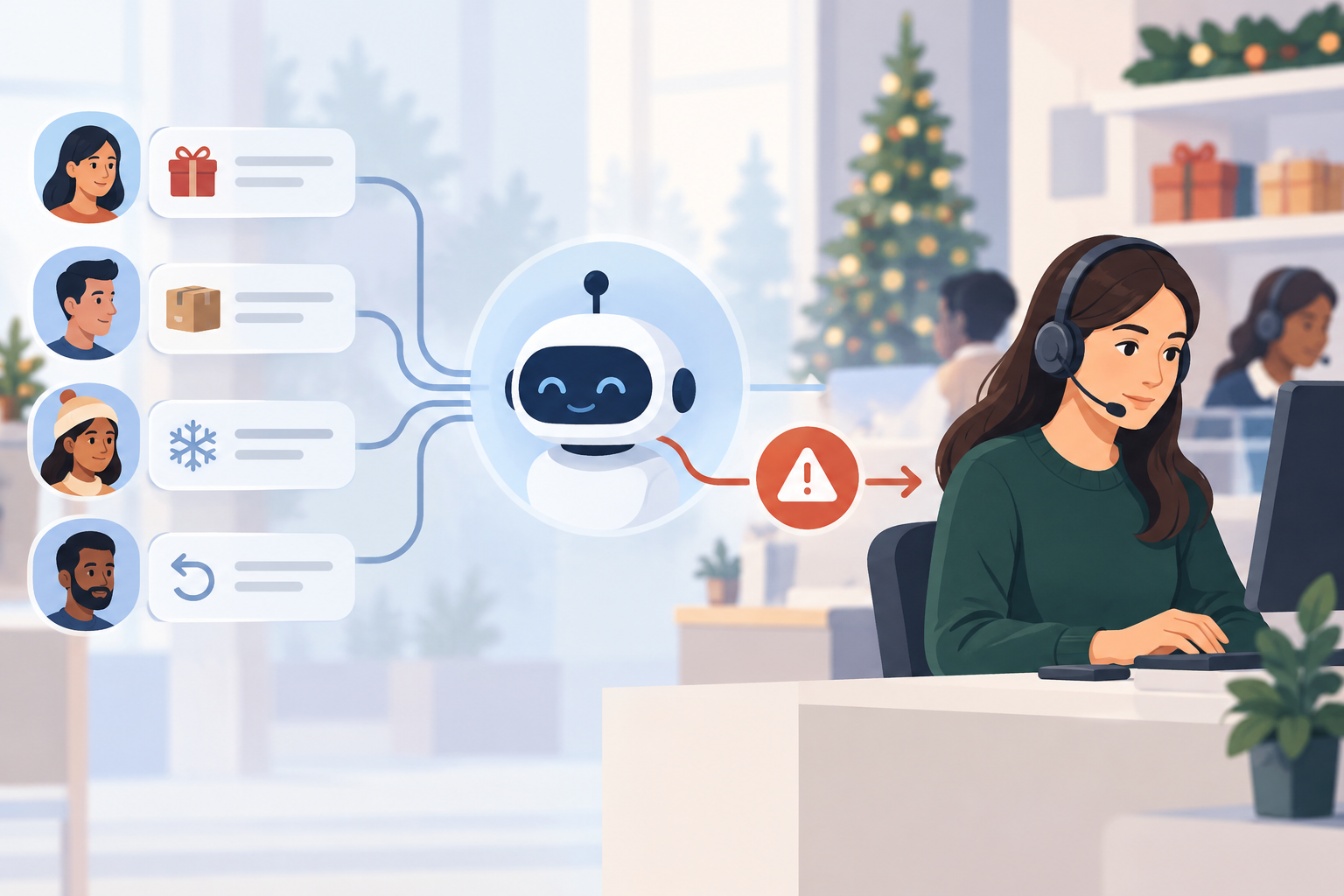 Automation isn't about removing people from the loop it's about making sure the right cases reach them fast. When an AI agent can't resolve something confidently (a damaged item dispute, a policy exception request, an angry customer), it should hand off to a human agent immediately, with full conversation history and context attached. No re-explaining, no cold handoff.
Good routing also means prioritizing by urgency and customer value, not just first-in-first-out. A high-value repeat customer with a shipping problem two days before a holiday deadline shouldn't sit behind a dozen routine refund-status questions that automation could have already answered. Built into a ticketing system, this kind of rules-based routing keeps response times predictable even as volume triples.
Keeping E-commerce Customer Service Consistent Across Channels
Holiday shoppers don't stick to one channel. They message on WhatsApp, email a question, then DM through social often about the same order. If those conversations live in separate tools, agents lose context and customers repeat themselves, which is exactly the friction that turns a minor issue into a complaint.
An omnichannel inbox solves this by pulling WhatsApp, email, and other channels into one thread per customer, backed by a shared CRM record. That consistency matters most during peak season, when a single customer might contact you two or three times about the same order through different channels and expect you to already know what happened the first time.
Building a Holiday-Ready AI Support Playbook for Next Year
The retailers who handle peak season smoothly aren't improvising in November they're running a playbook built from the previous year's data. That playbook should cover: which inquiry types to automate end-to-end (returns, order status, refund tracking), which triggers escalate to a human immediately, what response-time targets look like during peak versus normal weeks, and how WhatsApp broadcast messages can proactively answer common questions (shipping cutoffs, return deadlines) before customers even have to ask.
Review last year's ticket data for the questions that spiked and the ones that took longest to resolve. Those are your automation priorities for next season not guesses, but patterns from your own customers.
How mobitech Fits
mobitech.ai is built for exactly this kind of volume pressure. The AI agents handle first-line triage and resolution across WhatsApp Business API, email, and web chat, classifying returns, refunds, and general questions automatically and resolving the straightforward ones without agent involvement. Automation workflows connect that triage layer to your CRM and ticketing system, so eligible returns move through label generation, receipt confirmation, and refund issuance on rules you set not manual steps repeated hundreds of times a day.
When a case needs a human, it routes into the shared ticketing queue with full conversation history attached, so agents aren't starting cold. The omnichannel inbox keeps WhatsApp, email, and other channels in one customer thread, and WhatsApp broadcast lets you get ahead of predictable spikes shipping cutoffs, return deadlines, delay notices before they turn into inbound tickets. Pricing and plan details are on the pricing page.
If your team is bracing for another chaotic peak season, don't wait until the volume hits to figure out what to automate. Start a free trial of mobitech.ai and build your holiday-ready support stack before the rush.